A work experience section should make it easy to see what you did, where you did it, and why that work matters for the role you want next. “Responsible for marketing activities” leaves the reader to supply almost all of that information. A more useful bullet names the activity and shows how you carried it out.
You do not need a revenue figure in every bullet. You do need a description you could explain in an interview. This guide uses Lucia, a fictional marketing coordinator, to show how an ordinary list of duties becomes a clearer account of work. The companies and personal details are demonstration data.
Start with a record of the work, not a list of impressive verbs
Before rewriting, make a rough inventory of a typical week. What came into your queue? What did you prepare or check? Who used the result? Which decisions were yours, and which were made by someone else?
Lucia maintained an editorial calendar, prepared posts in Canva, coordinated reviews with designers, and summarized campaign results in Excel. She did not own the advertising budget and cannot connect her work to a specific increase in sales. Those boundaries are useful: they tell us which claims belong in her resume and which do not.
Use information you can substantiate from your own work records and recollection. You should not copy confidential customer data into an application. If a number cannot be shared, explain the type of work or the process without exposing it.
Make the employment record easy to follow
For each position, include a recognizable job title, employer, and dates. Use the same date style throughout the resume. A current role should look different from one that has ended; check that “Present” has not survived from an older draft.
An internal title may need a short explanation. “Content Associate — editorial coordination” can help an outside reader understand your scope. Changing that title to “Head of Marketing” would imply responsibilities you did not have.
List your most recent relevant experience prominently, then decide how much space each earlier role deserves. A short role with strong evidence for the new job can be more useful than a long description of unrelated duties. You can retain the complete history in your master profile without giving every item equal space in an application.
Turn duties into specific evidence
A useful review pattern is action, context, and outcome when an outcome is known. Treat it as a question about the information in a sentence, not a rigid formula that every bullet has to follow.
Original duty | Missing information | More useful wording |
|---|---|---|
Social media management | Channels and coordination | Planned the weekly calendar for Instagram, LinkedIn, and the blog, coordinating drafts and reviews with designers. |
Used Excel | Purpose of the spreadsheet | Consolidated campaign results in Excel and prepared weekly summaries of clicks, reach, and inquiries. |
Supported the team | Your own contribution | Prepared posts and visual assets in Canva using messaging agreed with the marketing team. |
The revised bullets do not invent a promotion or a sales result. They expose work that was already present in Lucia's notes. This is particularly useful when your role includes coordination, support, or administration: the detail shows the contribution more clearly than a broad job description.
Quantify an outcome only when the number has a meaning
A percentage needs a defined measure, a period, and a reasonable explanation of your part in it. “Improved performance by 30%” does not tell the reader whether you mean processing time, campaign engagement, or something else.
If a team achieved an improvement, distinguish your contribution from the whole result. You may have built the reporting view used to spot problems, coordinated follow-up, or implemented one part of a larger change. Describe that work rather than quietly claiming ownership of the entire project.
Check approximate figures before using them. When you cannot verify a number, write a clear description without it. You should be able to talk through the bullet in an interview without explaining that the number came from an AI suggestion.
Write meaningful bullets when you have no metrics
Scope, tools, and procedure can make a description useful. Think about the kinds of requests you handled, the documents you prepared, the checks you performed, and the people who depended on your work.
For example, “Logged order inquiries and coordinated follow-up with the shift supervisor” explains more than “Customer service.” It does not need an unsupported claim about retention. An operations bullet might describe checking invoices against records or maintaining a delivery tracker with owners and deadlines.
Avoid replacing missing numbers with “exceptional,” “world-class,” or “high impact.” These words still leave the work unexplained. A concrete sentence is easier for a reader to evaluate.
Select evidence for the job description
A job posting is a useful guide to relevance. If Lucia's target role asks for editorial scheduling, design coordination, and campaign reporting, her existing experience already contains evidence for those requirements. The first task is to make that evidence visible.
Terms such as “content calendar” or “campaign reporting” belong in the resume if they describe work she actually did. Adding unrelated software or repeating the same keyword in every bullet would create a different impression from the facts.
Read the resume tailoring guide to build a requirement-to-evidence comparison. If a requirement is missing, decide whether you have another genuine example or whether it is a gap. Stronger wording cannot turn a missing qualification into an existing one.
Keep your complete record in Ralue
The master profile lets you organize experience, education, projects, and skills as separate records. In the demonstration account, Lucia's content coordinator role and volunteer communications work have their own dates. Updating one record does not require merging the two activities into a single job.
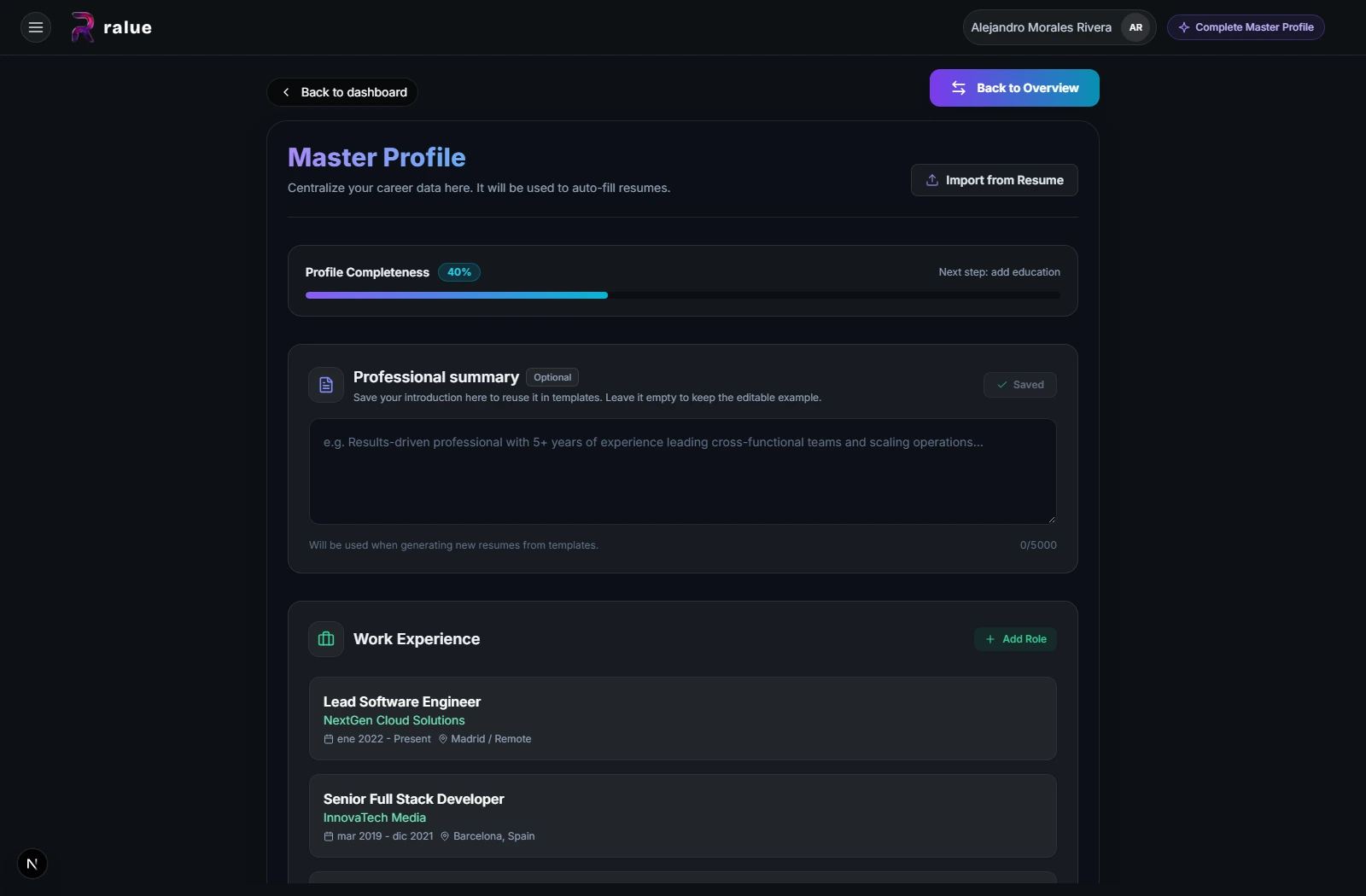
Review the resume separately after selecting the information you want to use. A fact stored in the profile is not proof that it appears correctly in the exported document.
If you ask the editor's assistant to rewrite a bullet, give it the factual boundaries. For example: “Make the calendar coordination and design reviews clearer. Keep my role and tools unchanged, and do not add revenue results.” Review the proposal before applying it. AI features have account usage limits.
Check the section as an interviewer would
For each bullet, ask what example you could describe if someone followed up. You should know the task, your contribution, and the result or purpose. If the answer belongs mostly to a colleague, adjust the wording to make your role clear.
Then read all the roles together. Repeating “managed,” “supported,” and “coordinated” can hide differences between positions. The solution is not to find a different verb for every line. It is to check whether each line adds evidence that the reader has not already seen.
Before submitting, open the exported file and review the association between dates, titles, and employers. See the PDF versus Word guide for file-format checks. The readable document and the relevant experience both need attention.
Common questions about the work experience section
Can projects or volunteer work count as relevant experience?
They can provide relevant evidence, especially when paid experience is limited. Label the activity accurately as a project, volunteering, an internship, or employment. Explain the work without presenting an unpaid activity as a job you did not hold.
How many bullets should each role have?
Use enough to explain the relevant contribution without repeating yourself. Begin with the strongest evidence and ask what each additional bullet adds. Recent directly relevant work may justify more detail than an older unrelated position.
Should every bullet start in the past tense?
Completed activities normally use past tense. Ongoing responsibilities in a current role can use present tense. What matters is that the dates and wording accurately distinguish current work from completed work, rather than making the timeline ambiguous.
What changes when I apply to the US or the UK?
For most US industry applications, this section belongs in a resume. UK employers often use “CV” for the corresponding application document. Follow the employer's terminology and instructions, and keep official job titles accurate; changing markets does not justify changing your work history.
Sources and further reading
Personal examples in this guide are fictional. Employers make their own hiring decisions; no template or score guarantees an interview.