An AI cover letter can be grammatically correct and still give an employer almost no reason to remember your application. If the company name is the only detail that changes, the draft probably needs better material before it needs more polishing.
A useful cover letter explains why you are applying and develops a piece of evidence that matters for the role. AI can help organize that material. It cannot independently know which responsibilities you held, why a company interests you, or whether a claimed result is accurate.
This guide uses Lucia, a fictional content coordinator applying for a marketing role. The personal details and employer names are demonstration data. We will use them to build and review a specific letter rather than to claim a real hiring outcome.
Check whether a cover letter is required and what it should answer
Start with the application instructions. Some employers request a letter, some provide an optional upload field, and others ask for answers to specific questions. A separate document is not automatically the right response to all three situations.
When a letter is optional, ask what useful context it would add. You might explain a relevant project, a career transition, or a connection between two parts of your experience. Repeating every job on the resume is unlikely to make that context clearer.
If the application has a short text field, adapt the structure to the available space. The opening, evidence, and closing can still work without a formal page layout. Follow the employer's word limit if one is given.
Prepare the material before asking AI to write
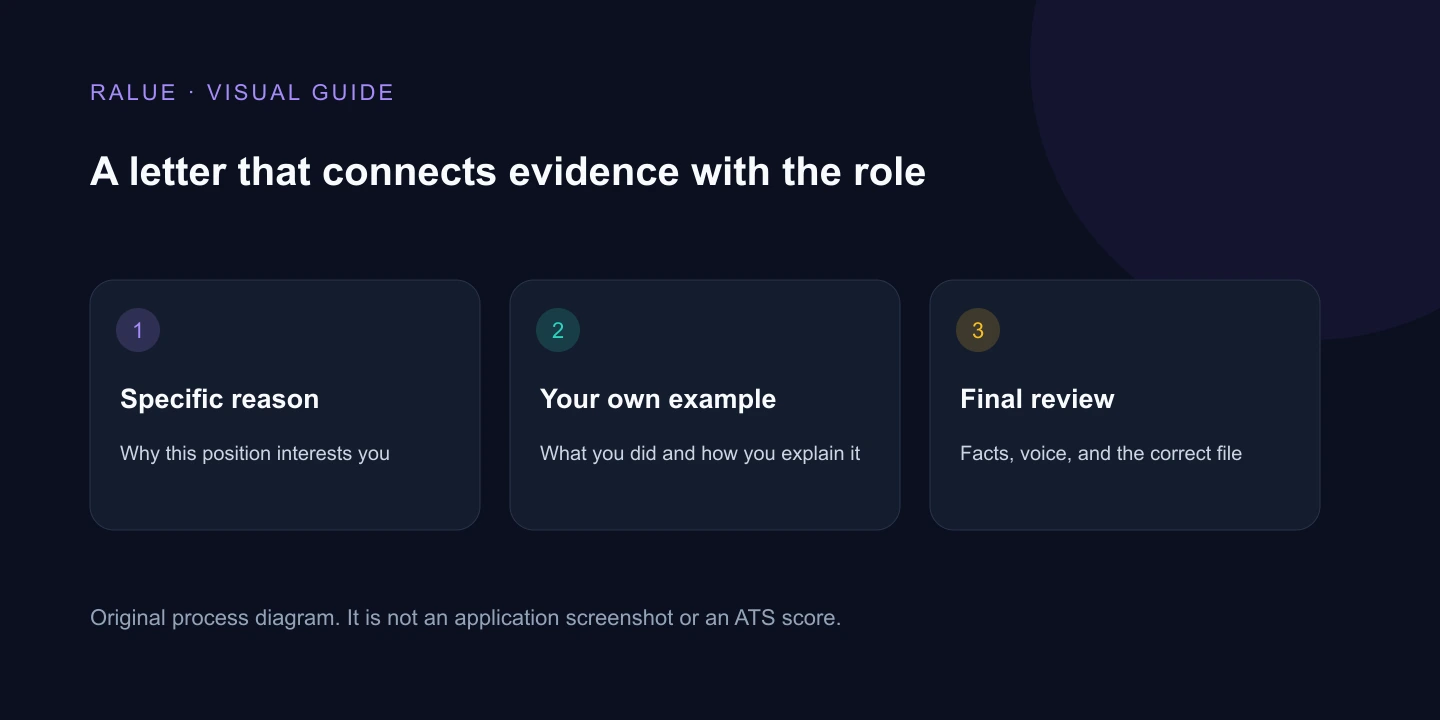
Write four notes: the target position, one responsibility that interests you, an example of related work, and a verifiable reason for choosing this employer. Use the posting or public company information for the last note.
Lucia's fictional posting asks for content scheduling, coordination with designers, and campaign reporting. She has examples of all three. She is interested in the combination because she has maintained calendars for Instagram, LinkedIn, and a blog while coordinating reviews and collecting results.
We have no evidence that she has used the employer's product for years or met its founders. Those details should not appear simply because they would create a warmer opening. Accurate specificity is more useful than invented familiarity.
Open with the position and the connection
A broad introduction can make the letter sound polished while saying very little. Consider the difference between these two openings.
Generic draft: “I am a highly motivated, results-driven professional eager to contribute my exceptional talents to your esteemed organization.”
Revised opening for the fictional case: “I am applying for the Marketing Coordinator position. My experience maintaining content calendars, coordinating design reviews, and preparing campaign reports matches the responsibilities described in your posting.”
The second version tells the reader what the application is about. It also creates a clear direction for the next paragraph: explain that experience. You do not need to compensate for a straightforward opening with a list of enthusiastic adjectives.
Develop one example instead of repeating your whole resume
Choose an example that connects several requirements. Lucia can describe the weekly calendar, the review process with designers, and the Excel summary used by the team. That shows how her tasks fit together.
It would be a different claim to say she led the entire marketing strategy or caused a specific increase in sales. Neither statement is present in the factual notes. A cover letter has the same obligation to accuracy as the resume.
Job requirement | Evidence to develop | Claim to avoid without support |
|---|---|---|
Content coordination | Weekly calendar and design reviews | Owned the whole company strategy. |
Campaign reporting | Consolidated weekly indicators in Excel | Increased sales by an invented percentage. |
Team collaboration | Followed up on drafts and deadlines | Managed a team when you did not. |
You can explain what you learned from the process, but keep the explanation connected to the work. “I learned to keep reviews and deadlines visible” is easier to understand than a sweeping claim about becoming an exceptional leader.
Give the AI a bounded drafting request
“Write a cover letter that gets interviews” supplies an outcome you want, not evidence the model can use. Give it the posting, your relevant facts, and the boundaries of the task.
A more useful request is: “Draft a brief cover letter for a Marketing Coordinator role. Use my experience with editorial calendars, Canva, design reviews, and Excel reporting. Keep the tone direct. Do not add revenue results, management responsibilities, or personal knowledge of the company. Flag missing information rather than filling it in.”
Review the result as a proposal. For each new claim, ask where it came from. You may decide to supply a genuine detail or remove the sentence. Fluency is not evidence.
A short example for a US industry application
The following letter uses only the fictional case facts:
Dear Hiring Team,
I am applying for the Marketing Coordinator position. The combination of editorial planning, design coordination, and campaign reporting in your posting closely matches my recent work.
At Delta Studio, I maintained the weekly calendar for Instagram, LinkedIn, and the blog. I prepared posts in Canva, coordinated draft reviews with designers, and brought campaign results together in Excel for the team's weekly reporting. That work required clear deadlines, shared review steps, and careful follow-up.
I would welcome the opportunity to discuss how I have organized that process and learn more about your priorities for the role. My resume is attached.
Thank you for your consideration.
Lucia Torres
This is a structure to adapt, not a template to submit with a different name. The opening identifies the position, the middle supplies evidence, and the closing offers a reasonable next conversation. Replace every personal claim with your own facts.
For UK applications, the employer may call the accompanying document a CV and use different conventions for the salutation or closing. Follow the wording and instructions of the process. Changing the market does not require making the letter more elaborate.
Use Ralue to organize facts and review the draft
The master profile can help you recover the experience that belongs in the letter. In the editor, the assistant can support document review, while you decide whether its suggestions are accurate. Ralue also has a dedicated cover letter workspace; check which document is open before saving or exporting.
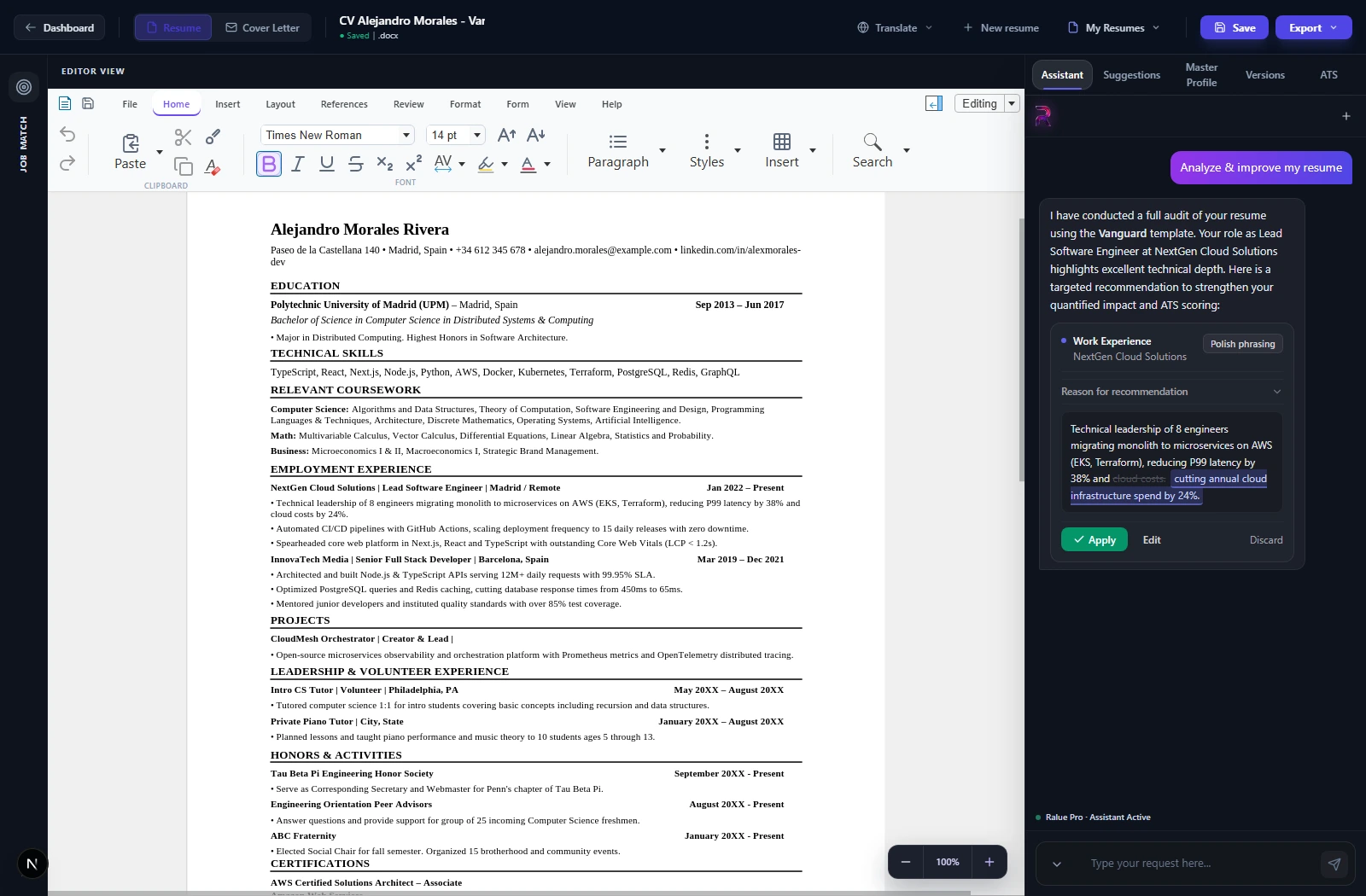
This screenshot shows the assistant with a demonstration resume, not a generated cover letter or a submitted application. It illustrates the review environment: supply relevant facts and retain control of the claims. AI features have account usage limits.
Use the work experience guide if your notes are still too broad. Once you have a clear example, the letter can develop it without inventing another story.
Edit for your voice rather than for an AI detector
Read the letter aloud. If a sentence is not something you would say in a professional conversation, simplify it. Check the employer name, position, dates, contact details, examples, and every number.
Removing stock phrases can improve the writing. It cannot guarantee the result of an AI detector or prove how the document was produced. What you can check is whether the letter is accurate, specific, and consistent with the way you explain your work.
Open the downloaded file before submitting it. Make sure the paragraphs survived, no drafting comments remain, and the filename belongs to the correct application. Keep a copy so you can recognize what you sent.
Common questions
Should I mention that I used AI?
Follow the application's instructions if it asks you to disclose tools. Regardless of the drafting process, you remain responsible for checking the content and being able to discuss the experience. Do not imply that a human expert reviewed the letter if no such review occurred.
What if I have no paid work experience?
Choose a relevant academic project, volunteer activity, or other genuine example. State its context accurately and explain your contribution. A specific project described as a project is stronger evidence than an invented employment history.
How long should the letter be?
Use the space needed for the reason and one or two relevant examples without repeating the resume. Respect any application word limit. A concise letter can do the job when the connection is clear; extra general paragraphs do not automatically make it better.
Sources and further reading
Personal examples in this guide are fictional. Employers make their own hiring decisions; no template or score guarantees an interview.